product studio
We build in weeks what until recentlywas considered impossible.
We love a hard problem: difficult things, delivered fast. The proof is not a deck, it is our own software, live and in use. We work for the value the client receives, and the price is set by that value delivered, not by hours.
We use AI only where it earns its place, with whatever technique and provider fit each case best. When simple automation solves it better, that is what we propose.
01 · tech demos
Public tech demos
Technical demonstrations built on real, public data, each one a different sector, problem and technology. Published with verifiable results: the wins, the misses and the caveats.
Improving a hospital roster that had not moved in sixteen years
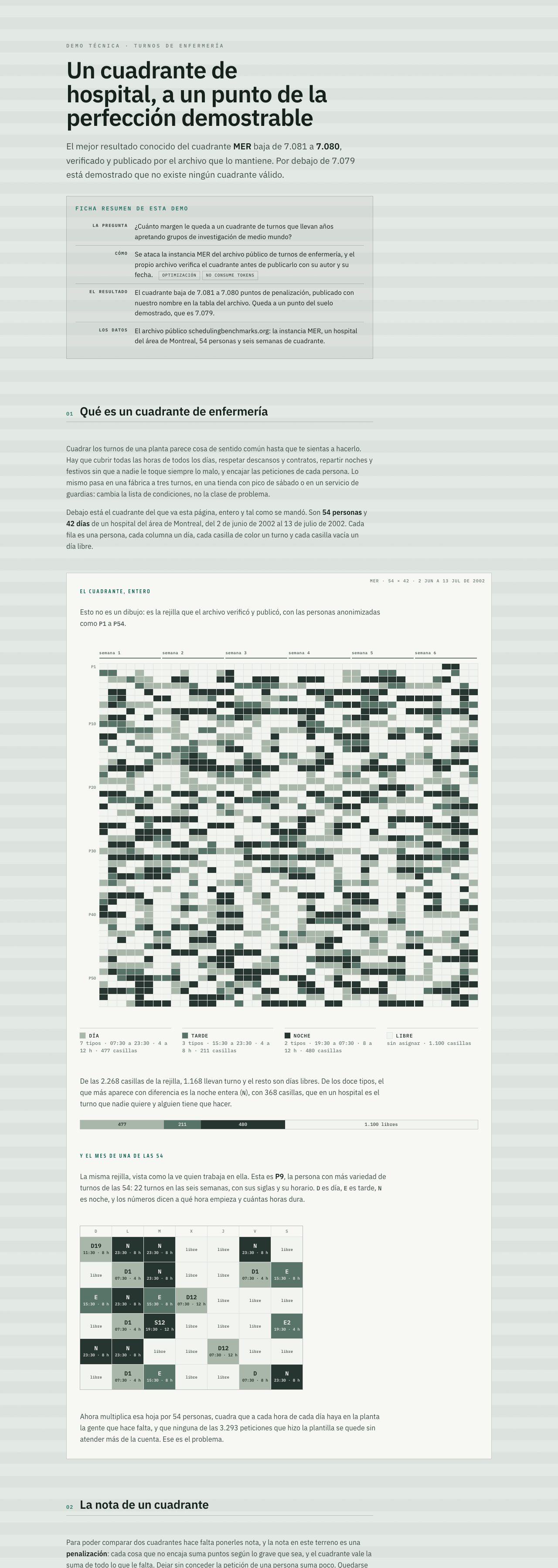
A real 54-nurse roster had been stuck at 7081 since 2010. We brought it to 7080 by moving 13 cells out of 2,268, and the published lower bound of 7079 proves perfection is at most one point away.
Electricity price, predicted every day
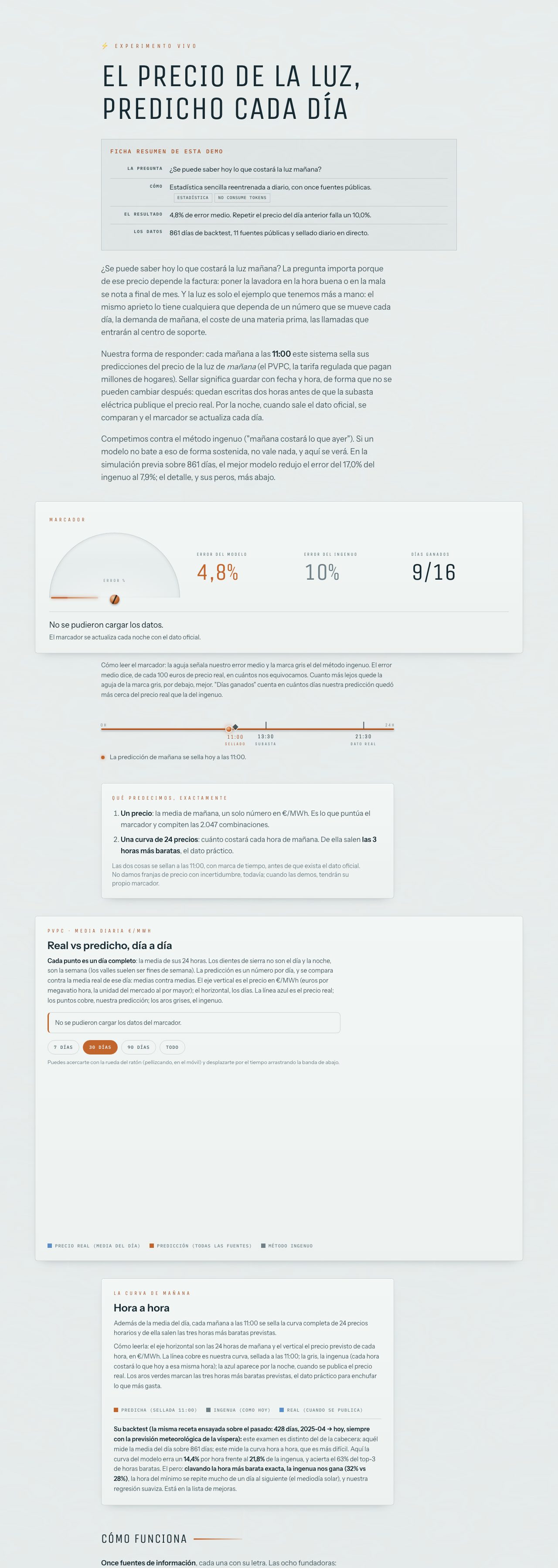
In the 861-day simulation, the best model cut the error from 17% to 7.9%. Updated daily against the real price.
Anticipating car recalls by reading driver complaints
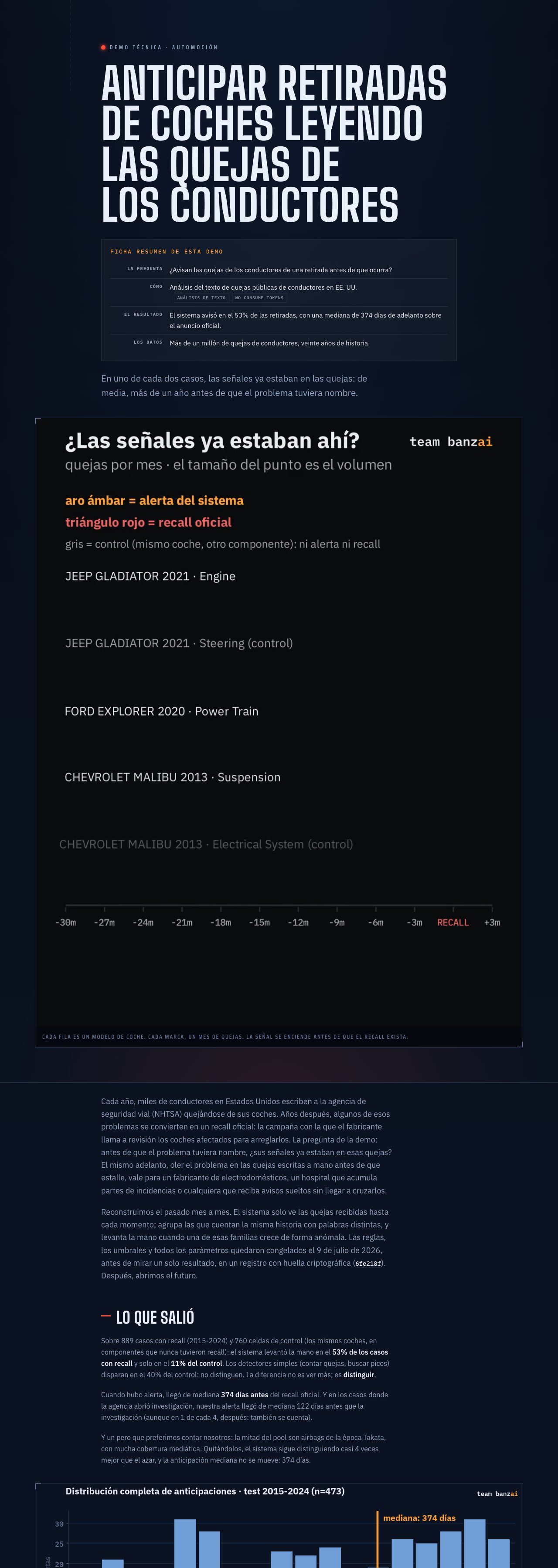
The system flagged 53% of recall cases, a median of 374 days before the official announcement.
Anticipating the discount and the empty tenders in public procurement
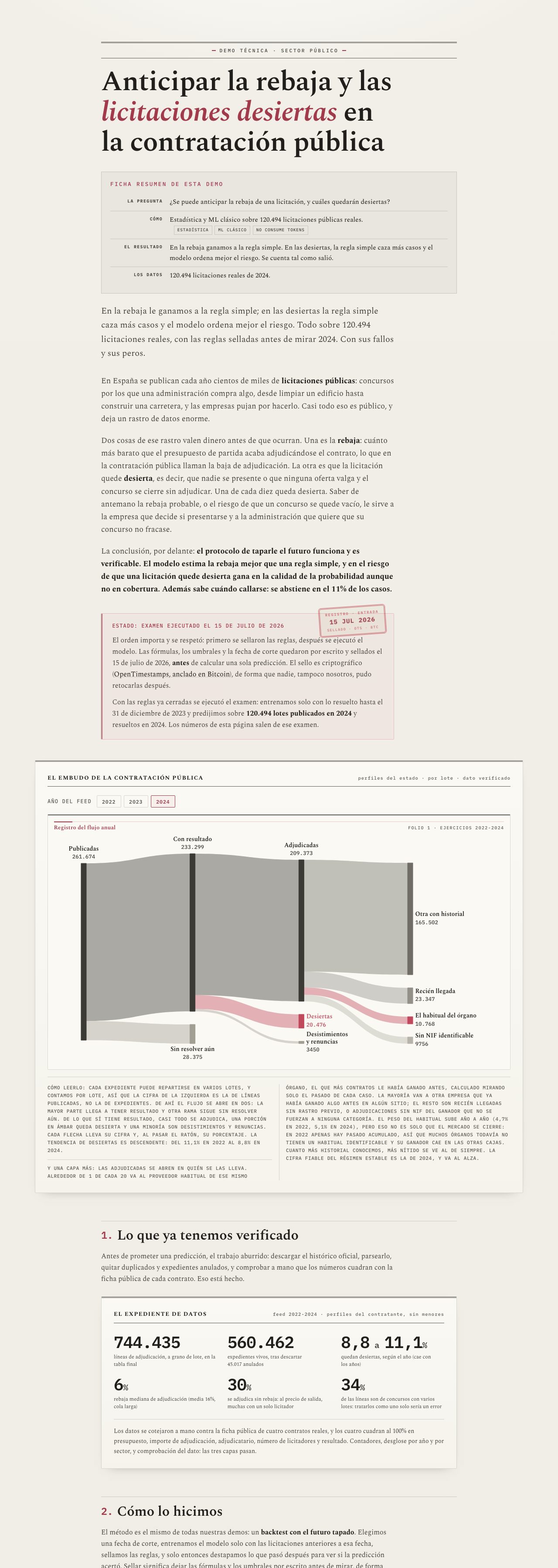
120,494 tenders from 2024, with the rules sealed before looking at the outcome.
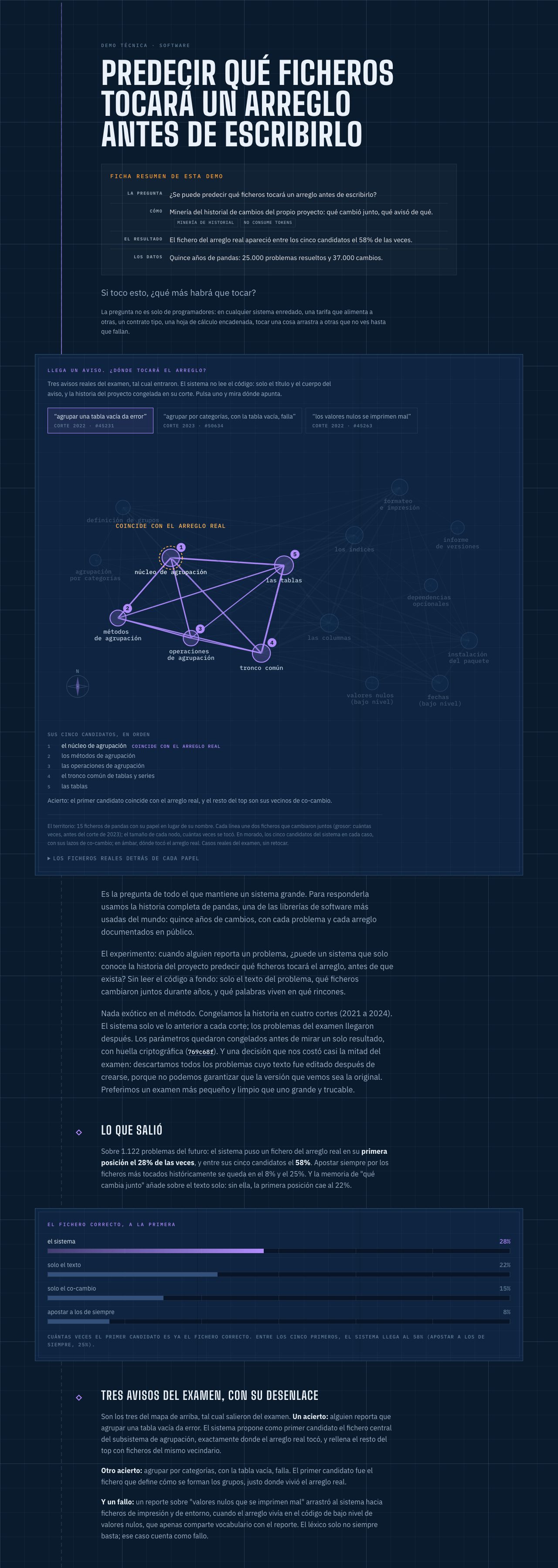
Predicting which files a fix will touch before it's written
The real fix's file showed up among the five candidates 58% of the time.
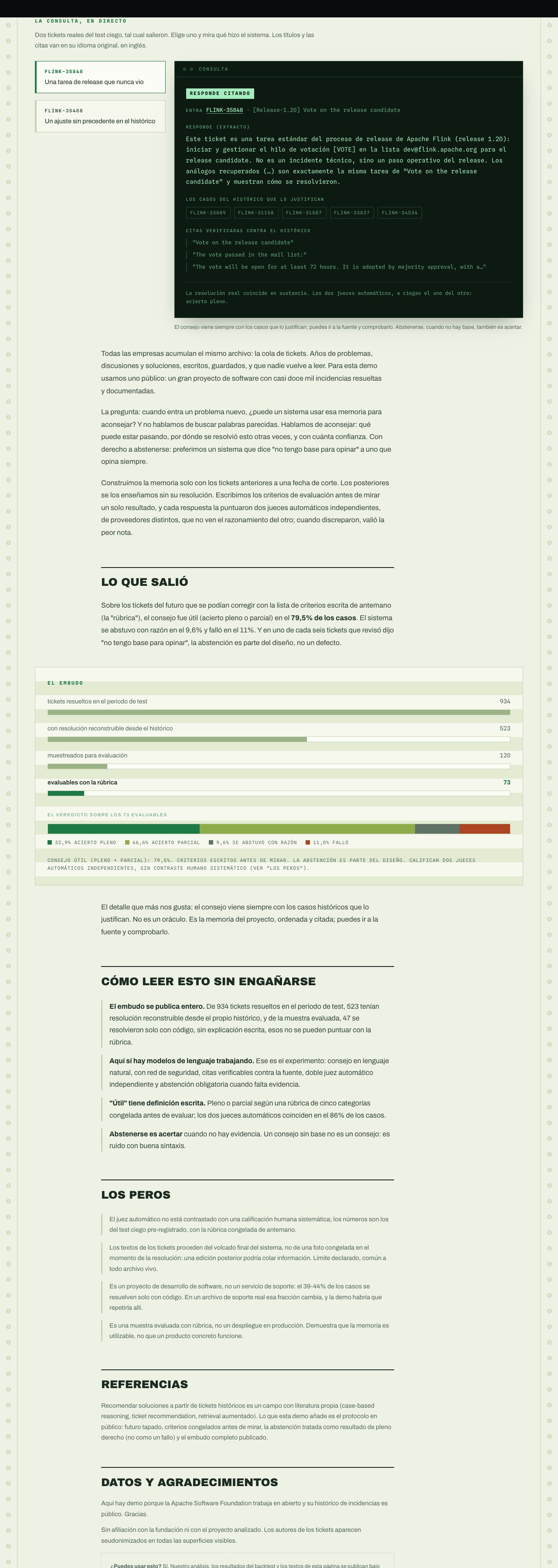
Advising on a never-seen ticket with years of incidents
Useful advice on 8 out of 10 of the 73 gradable tickets. Abstention is part of the design.
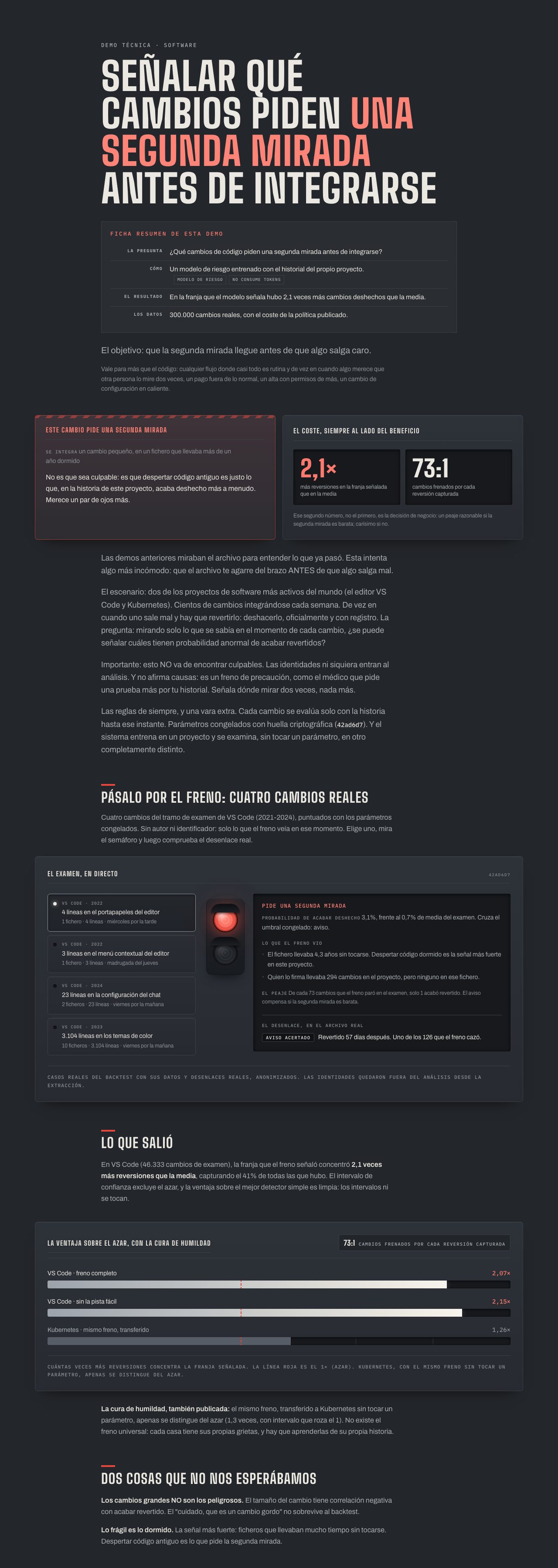
Flagging which changes deserve a second look before merging
The flagged band held 2.1 times more reverted changes than the average.
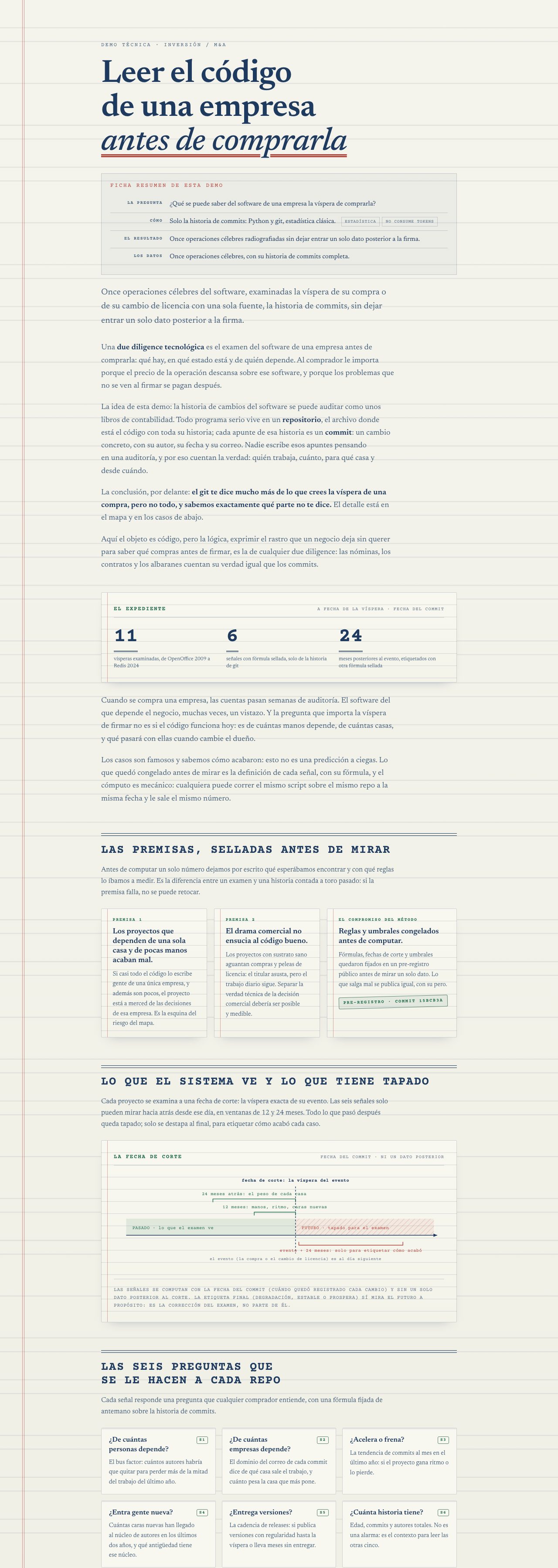
Reading a company's code before you buy it
Eleven real acquisitions and licence changes, X-rayed on the eve of the announcement.
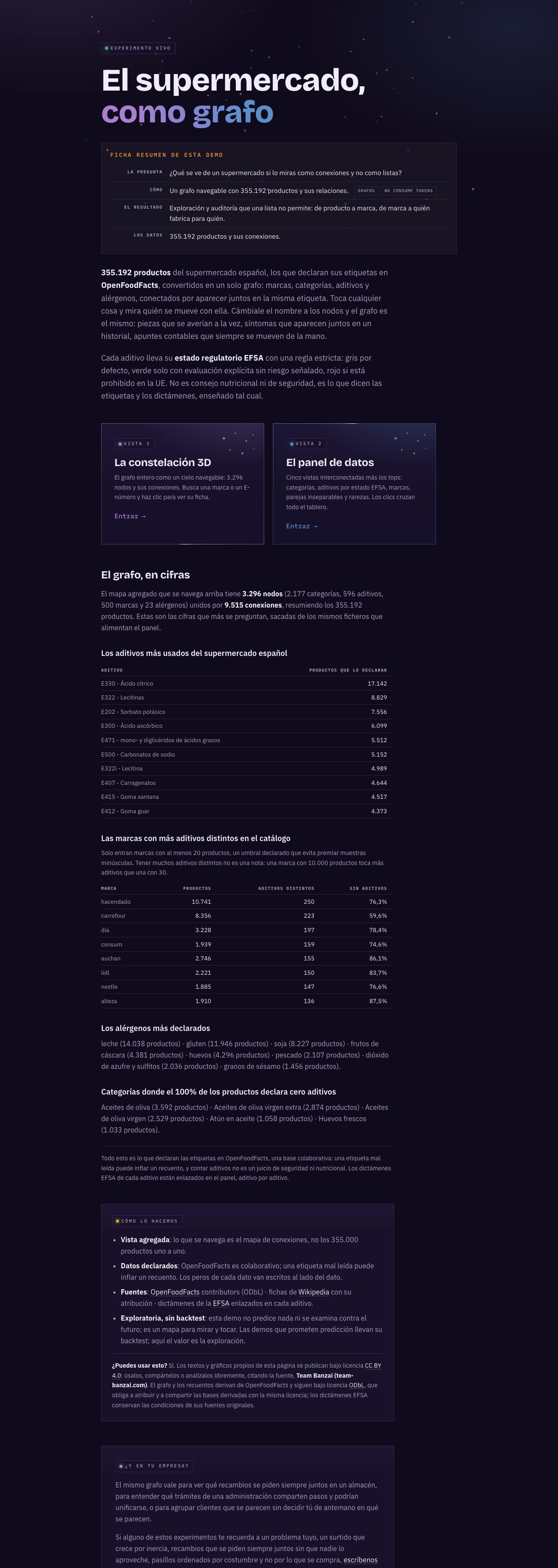
The supermarket, as a graph
355,192 products and their connections, in a navigable graph. Exploratory, no backtest.
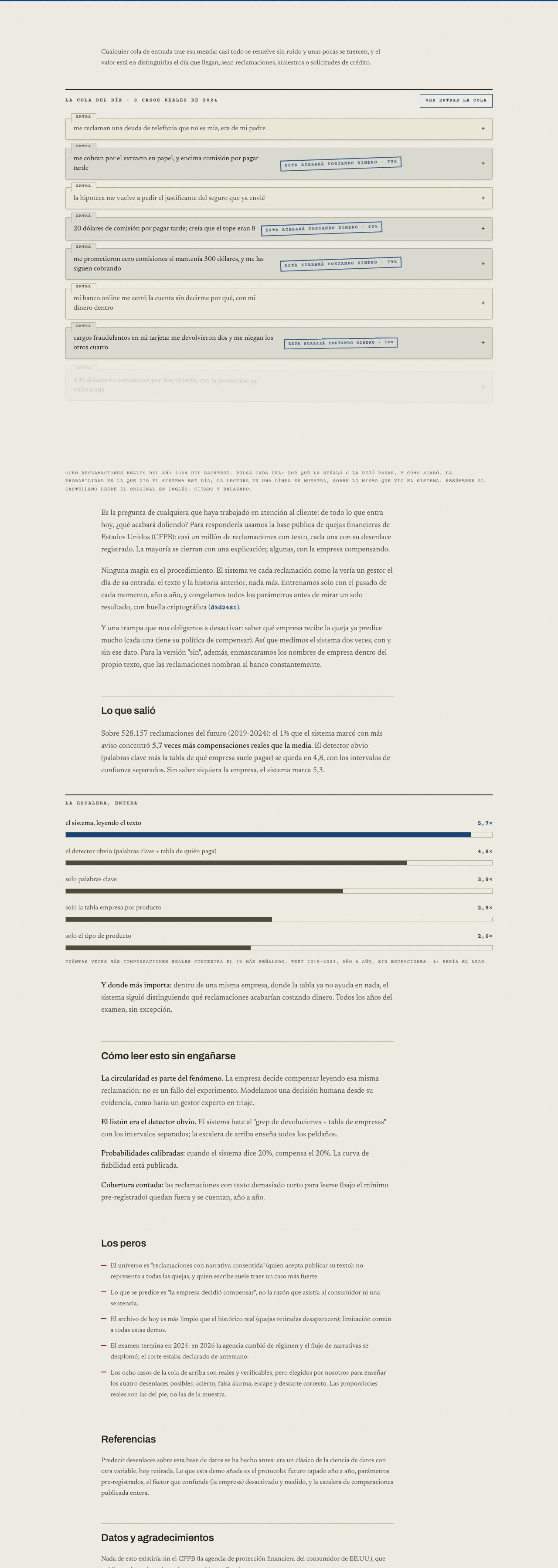
Knowing which claims will cost money the day they arrive
The 1% it flagged hardest concentrated 5.7 times more real compensations than the average.
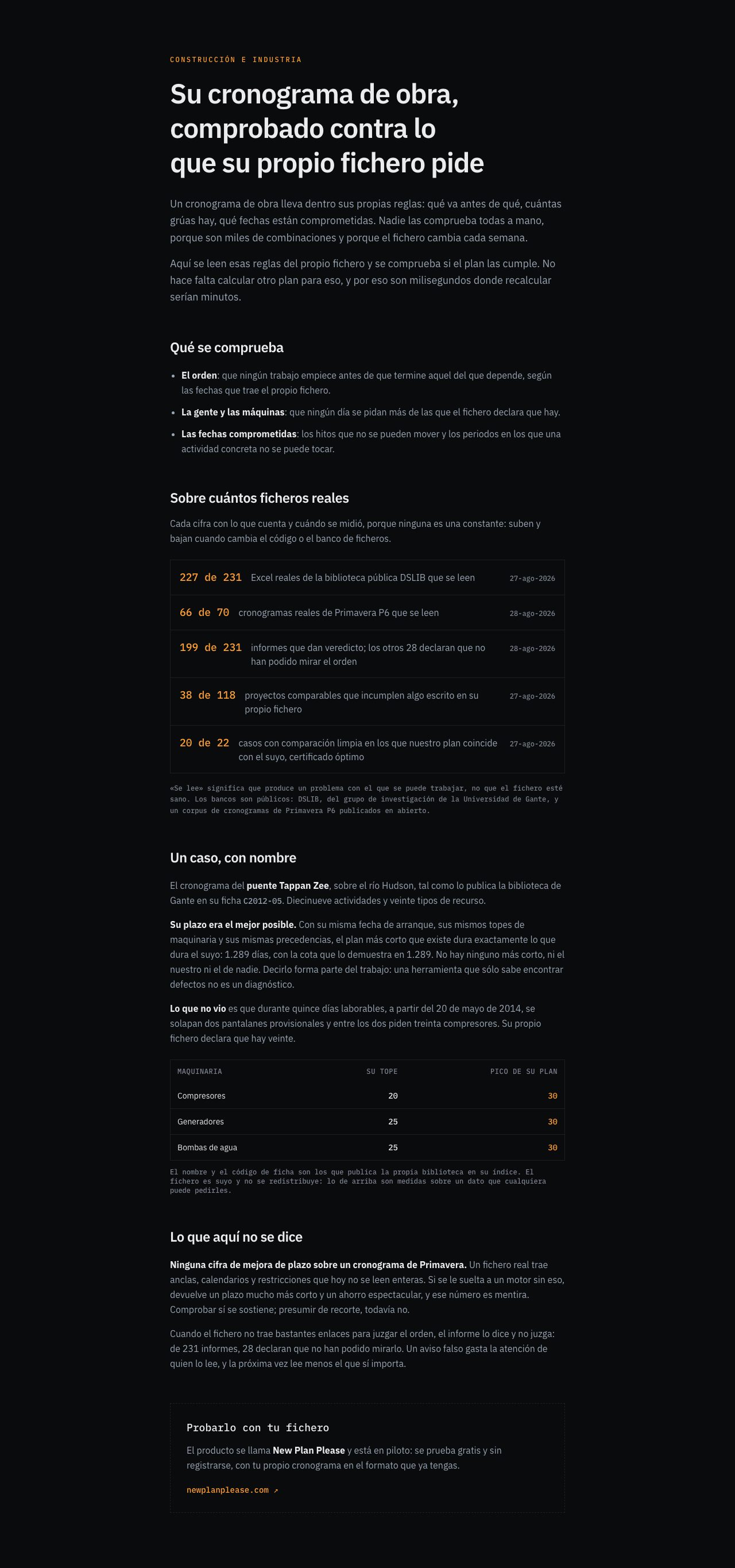
Your construction schedule, checked against what its own file asks for
Of 118 comparable projects, 38 breach something written in their own file (27 Aug 2026). The largest, at 1,419 tasks, is checked in 0.64 seconds.
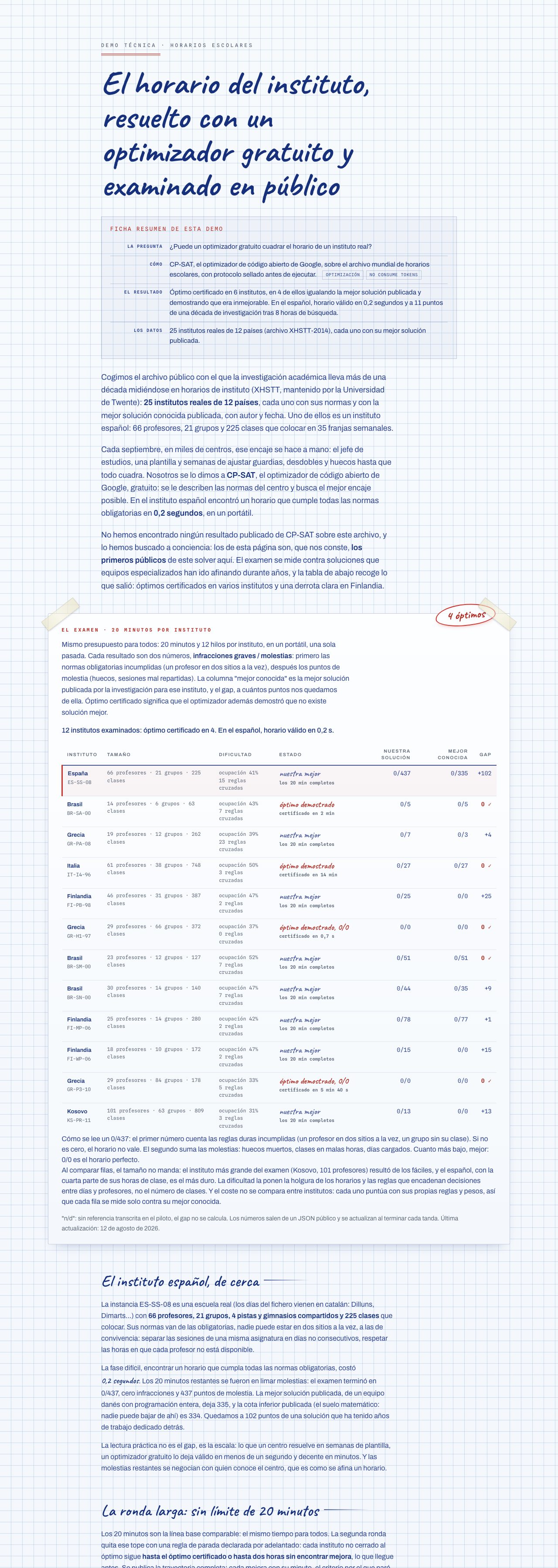
Solving a real school's timetable with a free optimizer
Certified optimum in 8 of the 12 schools examined, matching in all of them the best published solution. The Spanish school's timetable comes out valid in 0.2 seconds.
PUBLIC TECH DEMOS, MORE ON THE WAY
02 · products
We build our own products.
Team Banzai is a studio that builds and runs its own products: each line starts from a specific problem and ships under our own name. Six today.
TeachThemAll
educationComplete class material generated with AI, with its charts, maps and diagrams, in twelve languages.
hoyestudia
exam prepAI-assisted prep for Spanish civil-service exams, on web and mobile.
New Plan Please
planning · pilotChecks and recomputes construction, project and staff schedules. In pilot.
Supply Chain Domino
price risk · pilotWhich of the raw materials behind your costs are more likely than usual to move sharply this week, and what the news says in the countries you buy from.
03 · capabilities
One team for the whole stack.
From the AI model to the launch video: if the product needs it, it gets built here.
2 products in production · apps on the App Store and Google Play · material in 12 languages · experiments with verifiable backtests
04 · recognition
Recognition and publications
Independent academic archives that publish our results, under our name, and the deposits where each certificate lives. State as of 15 October 2026. One entry is a test we ran ourselves on a public benchmark, with nothing deposited.
- Published by third parties Finalists of the ROADEF/EURO Challenge 2026 International optimization challenge run by ROADEF and EURO, on a problem from Orange Research: routing traffic in a large telecommunications network while maintenance work is carried out. 155 teams registered and 73 submitted a solution in the qualification round. We ranked 11th. The organizer told the teams that everyone who scored goes through to the final, and in its table that is the top 30. The final will be decided at the ROADEF 2027 conference. Table published on 5 October 2026.
- Published by third parties Nurse rostering portal, University of Nottingham Three results credited to Alfonso Gippini Requeijo, Team Banzai S.L. Instance MER at 7080, the best known solution, published on 17 August 2026. BCV-3.46.1 at 3277 and HED01b at 83, a proved optimum, on 22 August.
- Published by third parties MRCPSP best known results table, Ghent University Results for 81 instances across MM50, MM100 and MMplus, credited to Alfonso Gippini Requeijo, Team Banzai S.L., found with an exact constraint programming method. For 70 of the 81, the best known value in the portal is ours. For 34 of the 81, the result is a proved optimum. Published on 14 September 2026.
- Published by third parties MIPLIB 2017 library, Zuse Institute Berlin MIPLIB is the reference collection of mixed integer programming problems. Two of its instances, graph40-40-1rand and graph40-80-1rand, were listed as open. The page for each now lists the optimum as proven, cites the paper with the proof, and notes an independent verification by Alfonso Gippini Requeijo.
- Published by third parties Andries Brouwer's table of constant weight codes The reference table of bounds for binary constant weight codes. Since 1 October 2026 it lists two improved cells credited to Alfonso Gippini, A(29,6,9) ≥ 14,313 and A(29,6,10) ≥ 25,896 (previously 13,026 and 24,254), with both codes linked from the table.
- Own deposit Covering numbers C(18,11,3) = 10 and C(20,12,3) = 10 Combinatorial design: C(v,k,t) is the least number of blocks of k points, taken from v, needed so that every group of t points fits inside some block. The Covering Repository, the reference table, listed for these two cells a covering with 10 blocks, known since 1996, and a lower bound of 9. We prove that no covering with 9 blocks exists, so the exact value is 10 in both. The argument is split into 35 DRAT proofs, all accepted by the drat-trim checker, and the deposit also includes the two 10-block coverings. Deposited on 14 October 2026.
- Own deposit A certified lower bound of 2239 for BCV-3.46.1, a nurse rostering case Nurse rostering: in the schedulingbenchmarks.org archive, the best known solution for BCV-3.46.1, with a penalty of 3277 points, is ours, and until 15 October 2026 the archive listed no lower bound for this case. We prove that no valid roster goes below 2239 points. Every rule of the case applies to a single employee, except the cover rules, which can only add penalty, so the total cannot go below the sum of the least penalty of each of the 46 employees taken separately. That step is an argument on paper. For each employee, a computer proof shows that their part cannot go below a given value, and the 46 values add up to 2239. All 46 proofs are accepted by VeriPB and by CakePB, a checker whose correctness is formally proved. A separate program checks that each proof encodes the rules of the case according to a written specification. Whether that specification counts the penalty exactly as the archive does has been tested against the 10 published solutions of the case, but not proved. Version 2, with the certificates, deposited on 15 October 2026. The schedulingbenchmarks.org maintainer has listed the bound of 2239 on its lower bounds page since 15 October 2026, credited to Alfonso Gippini Requeijo.
Accepted Bound of 2239 published by the maintainer at schedulingbenchmarks.org since 15 October 2026.
- Own deposit Thirteen production plans below the 2002 reference values of the Stadtler and Suerie benchmark Multi-level capacitated lot sizing (MLCLSP), class B+ of the Stadtler and Suerie benchmark. For 13 instances we give a feasible plan that costs less than the best value in the 2002 reference sheet, solutionsbp.xls. For example, the cost of test0048 goes from 138,916.69 to 134,202.56. An independent checker, included in the deposit, verifies each plan in exact arithmetic. The comparison is only against that 2002 sheet: three later papers that might hold lower values could not be read. Deposited on 14 October 2026.
- Own measurement How our planning engine handles input data with errors What our planning engine does when the data contains errors. The test takes two instances of class B+ of the public MLCLSP benchmark by Stadtler and Suerie and builds 64 cases with one error each, of 16 types in six families: negative or absurd quantities, inconsistent dates, duplicates, orphan references, missing routings and zero capacity. In all 64 the engine flags the data with a code from its catalogue of data errors, sets the faulty data aside or warns about it, and plans the rest. Leaving out the zero capacity cases, which have nothing to compare against, demand without errors is still served: a median of 100% per case, and 88.8% in the worst one. With valid data, in 20 control cases, it raised no false alarm. In four of the types that should be set aside, such as demand for an item that does not exist, it warns and does not plan that data, but leaves it in the input. It does not measure several errors at once, real customer data or special constraints such as overtime, minimum lot sizes or shelf life. Measured on 15 October 2026.
AMPE This is the engine behind AMPE, our production planner. Product page, in Spanish →
- Own deposit A certified lower bound of 148 on DIMACS graph C4000.5 The chromatic number of C4000.5 has been open since the nineties (the DIMACS challenge, 1993). The graph has 4,000 vertices and 4,000,268 edges. In a subgraph of 2,500 of those vertices we prove that no 18 are pairwise non-adjacent. Since adjacent vertices cannot share a colour, at most 17 of them can share one, so that subgraph needs at least 148 colours, and whatever a part needs the whole graph needs too. The best published bound was 107, by Held, Cook and Sewell (2012), and our previous ones, 111 and 139. VeriPB checks the proof, and CakePB, a checker whose correctness is formally proved, also checks its main part. Deposited on 14 October 2026.
- Own deposit A certified lower bound of 118 on DIMACS graph C2000.5 Graph colouring: 2,000 vertices and 999,836 edges. We prove that no 18 vertices are pairwise non-adjacent, and since adjacent vertices cannot share a colour, each colour can go on at most 17 vertices, so at least 118 colours are needed. The best published bound was 99, by Held, Cook and Sewell (2012). VeriPB verifies the proof, and CakePB, a formally verified checker, also checks its main part. Deposited on 8 October 2026.
- Own deposit Proved optimum for behnke29, a flexible job shop in FJSPLib Production scheduling: 20 jobs and 40 machines, where each operation can run on several machines. What is measured is when the last job finishes. FJSPLib, the reference collection, still lists it as open: it knows a schedule that finishes at 117 time units and a lower bound of 116, meaning that no schedule finishes before 116. We prove that none finishes at 116 either, so the optimum is 117. Version 2 of the deposit adds a proof that does not depend on the solver used in the first. The question "is there a schedule that finishes at 116 or earlier?" is written as a true or false logic formula (SAT), and the proof that it has no solution is accepted by drat-trim, lrat-check and cake_lpr, a checker whose correctness is formally proved. It also includes the 117 schedule and a checker. Version 2 deposited on 12 October 2026.
- Own deposit Two constant weight codes that improve Brouwer's table Coding theory: 29-bit words with a fixed number of ones that differ from each other in at least 6 positions. The reference table, maintained by Andries Brouwer, listed 13,026 words with nine ones and 24,254 with ten. Our codes have 14,313 and 25,896 words and include a verifier. Deposited on 1 October 2026.
- Own deposit A 216-word binary code of length 16 that corrects two deletions Coding theory: 16-bit words that stay distinguishable even if two bits are lost, a problem studied for DNA data storage. When we deposited it, on 29 September 2026, the largest reported code of this kind had 215 words (Weindel and Heckel, 2026). Codes with 218 and 219 words have since appeared on EinsteinArena, so our 216-word code is no longer the largest known. The deposit still includes the verifier.
- Own deposit Optimality certificates for two MIPLIB 2017 instances The optima of graph40-40-1rand (-9) and graph40-80-1rand (-7) were proved by Bergner, Lübbecke and Witt in 2016. The deposit adds what their paper did not include: a machine-checkable certificate for each instance. Deposited on 28 August 2026.
- Own deposit Improved bounds and proved optima on the MMLIB benchmark The certificates and schedules behind the results listed in the Ghent table. Deposited on 2 September 2026.
- Own paper Five improved bounds on IHTC-2024, on arXiv A paper on arXiv (math.OC) that explains the five improvements on the IHTC-2024 hospital scheduling benchmark: it starts from the published solutions and solves the nurse-to-room-and-shift layer to optimality. Published on 2 October 2026.
- Own deposit Improved solutions for five IHTC-2024 instances Integrated healthcare timetabling: five improved upper bounds, with every solution run through the official validator. Four of them, i02, i05, m01 and m03, have been in the organisers' table of best values since 25 August 2026, and the table names no author. Deposited on 22 August 2026.
- Own deposit Improved solutions for eight MSS instances Medical student scheduling, Dataset 2 of the benchmark by Zanazzo, Ceschia, Dovier and Schaerf. For eight instances, a solution better than the best published one, checked with the authors' own model. Deposited on 28 September 2026.
- Own deposit Independent confirmation of two optima on the PSPLIB j120 benchmark Resource-constrained project scheduling: optimum 105 for j120 1_1 and optimum 90 for j120 14_7. Both were first established by Heinz, Vilím and Hanzálek in 2025. The deposit confirms them with a different engine and records that the public PSPLIB and Ghent tables predate these values. Deposited on 2 September 2026.
- Own deposit Verified solutions for five results on open scheduling benchmarks A compendium that is versioned rather than duplicated. The identifier always resolves to the latest version.
05 · the problems we pick
The problems we choose.
Every now and then we take on a problem that isn't ours. We pick it if it meets three tests:
It has a number.
Hours a month, money leaking, risk, cycle time. If you can measure it, we can target it.
It can't be fixed from inside.
Your vendor won't move it, the backlog buries it, the committee won't decide. The blocker is rarely technical.
It fits in weeks.
No six-month transformations. If you can't picture it shipped within a quarter, it's not for us.
06 · studio
A small studio
with serious firepower.
We are Team Banzai. A small studio with a lot of firepower: behind it, almost thirty years of technology inside large organisations, and one conviction we have already put to the test: many things we assumed were expensive, slow or impossible no longer are. We build to prove it.
07 · contact
Let's talk.
Got one of those problems everyone calls impossible? Write us and we'll take a look.
[email protected]